Between old walls,new stories grow


11月10日,《中国日报》国际版刊登报道“Between old walls, new stories grow”(老墙新事),讲述苏州如何通过精心修缮,使文物建筑更加安全、稳固,同时保留其建筑特色和城市烟火气。
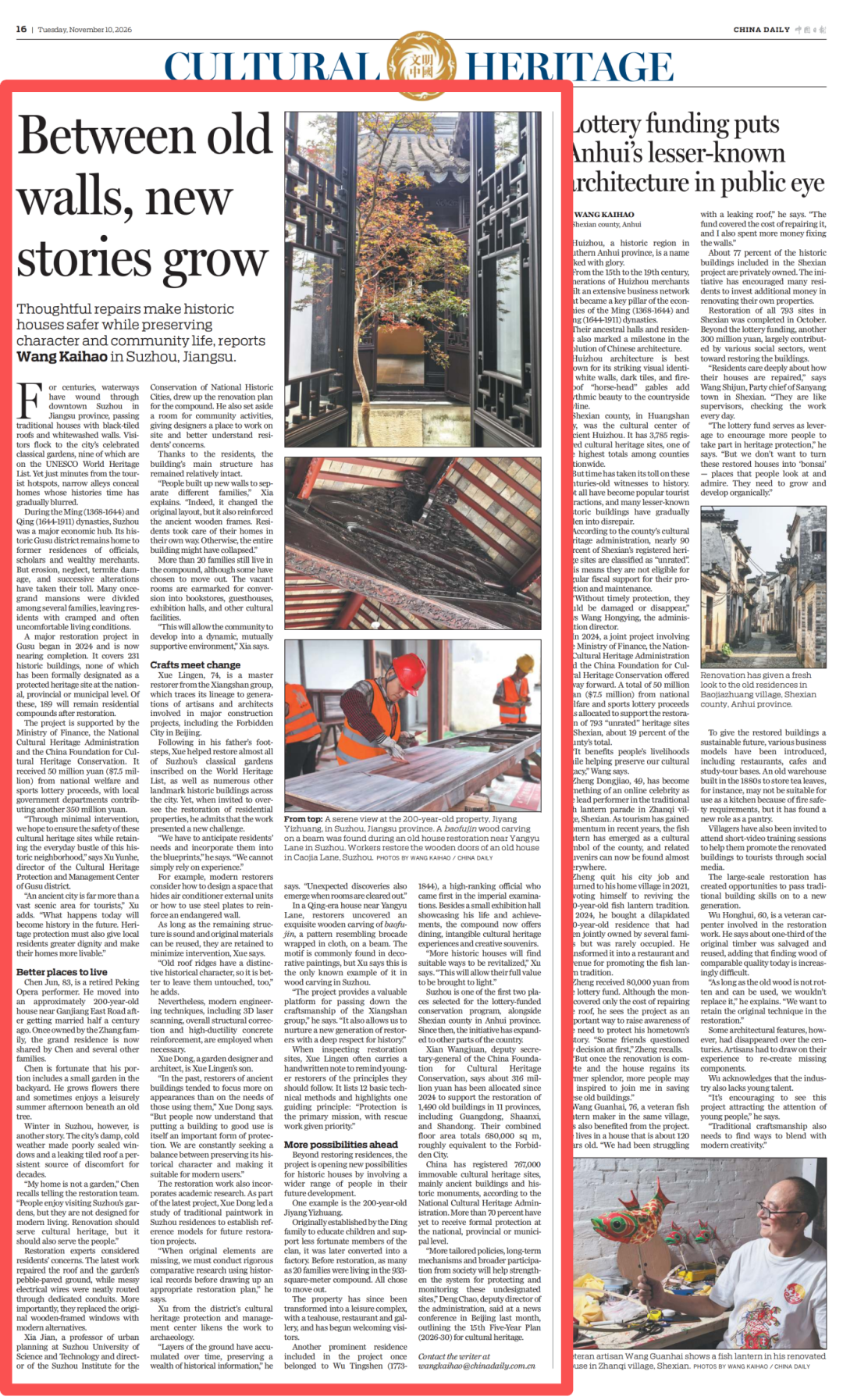
Between old walls, new stories grow
Thoughtful repairs make historic houses safer while preserving character and community life, reports Wang Kaihao in Suzhou, Jiangsu.
老墙新事
文章介绍,苏州姑苏区自2024年起对231处未定级文物建筑实施修缮,其中189处在修缮后仍作为民居使用。工程坚持“最小干预”原则,在保障建筑安全的同时,保留社区日常生活。修缮内容包括修复屋顶、规整线路、更换现代窗户、增设空调室外机位等,并回应居民对宜居生活的需求。“香山帮”匠人将传统工艺与现代技术相结合,运用三维扫描、结构纠偏等手段,并开展油漆工艺研究,为后续修缮提供范本。项目还探索活化利用,将部分老宅改造为茶馆、展厅等文化空间。专家强调,古城不仅是景区,文物保护应让居民更有尊严、生活更加宜居。该模式已推广至全国11个省份,支持1490座老建筑修缮,体现“保护为主、抢救第一”和多方参与的理念。
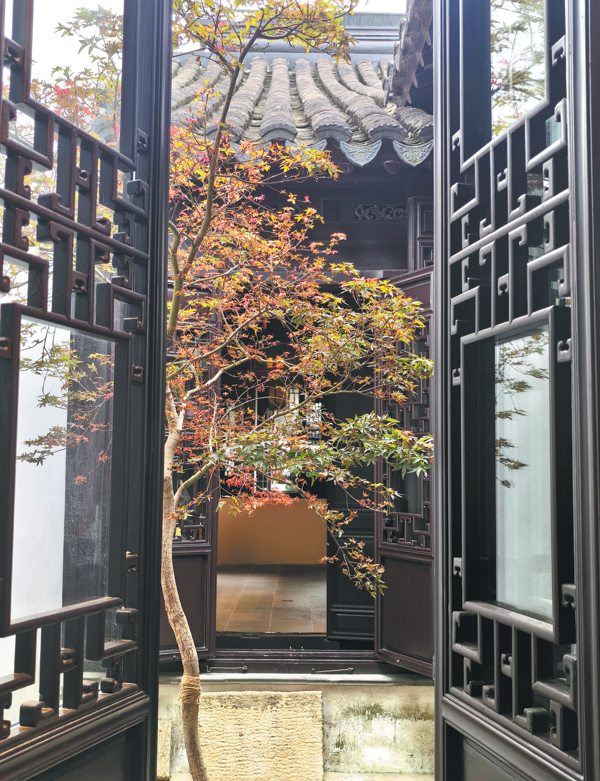
A serene view at the 200-year-old property, Jiyang Yizhuang, in Suzhou, Jiangsu province. [PHOTO BY WANG KAIHAO/CHINA DAILY]
For centuries, waterways have wound through downtown Suzhou in Jiangsu province, passing traditional houses with black-tiled roofs and whitewashed walls. Visitors flock to the city's celebrated classical gardens, nine of which are on the UNESCO World Heritage List. Yet just minutes from the tourist hotspots, narrow alleys conceal homes whose histories time has gradually blurred.
During the Ming (1368-1644) and Qing (1644-1911) dynasties, Suzhou was a major economic hub. Its historic Gusu district remains home to former residences of officials, scholars and wealthy merchants. But erosion, neglect, termite damage, and successive alterations have taken their toll. Many once-grand mansions were divided among several families, leaving residents with cramped and often uncomfortable living conditions.
A major restoration project in Gusu began in 2024 and is now nearing completion. It covers 231 historic buildings, none of which has been formally designated as a protected heritage site at the national, provincial or municipal level. Of these, 189 will remain residential compounds after restoration.
The project is supported by the Ministry of Finance, the National Cultural Heritage Administration and the China Foundation for Cultural Heritage Conservation. It received 50 million yuan ($7.5 million) from national welfare and sports lottery proceeds, with local government departments contributing another 350 million yuan.
"Through minimal intervention, we hope to ensure the safety of these cultural heritage sites while retaining the everyday bustle of this historic neighborhood," says Xu Yunhe, director of the Cultural Heritage Protection and Management Center of Gusu district.
"An ancient city is far more than a vast scenic area for tourists," Xu adds. "What happens today will become history in the future. Heritage protection must also give local residents greater dignity and make their homes more livable."
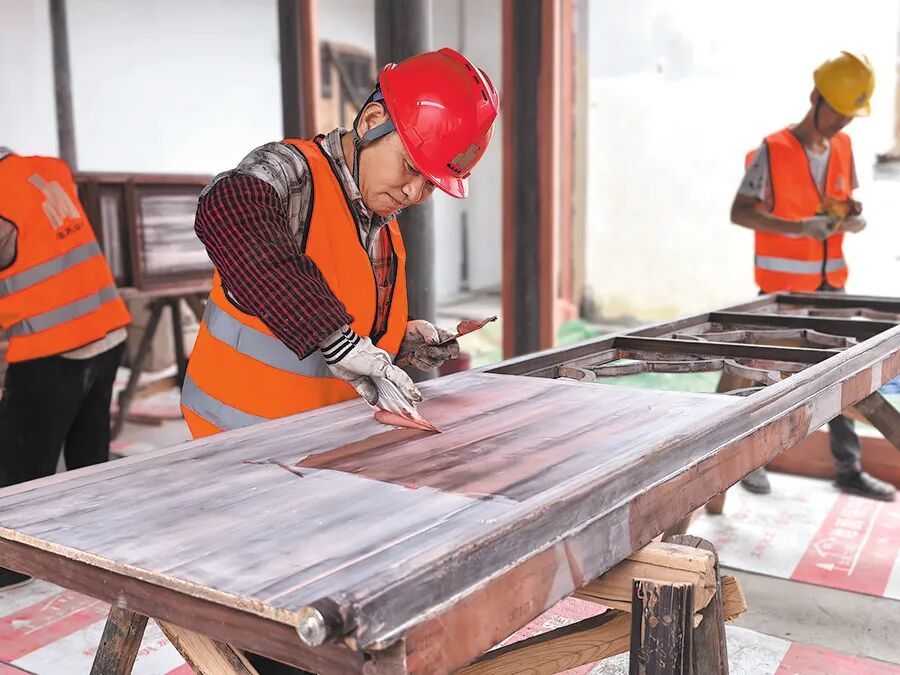
Workers restore the wooden doors of an old house in Caojia Lane, Suzhou. [PHOTO BY WANG KAIHAO/CHINA DAILY]
Better places to live
Chen Jun, 83, is a retired Peking Opera performer. He moved into an approximately 200-year-old house near Ganjiang East Road after getting married half a century ago. Once owned by the Zhang family, the grand residence is now shared by Chen and several other families.
Chen is fortunate that his portion includes a small garden in the backyard. He grows flowers there and sometimes enjoys a leisurely summer afternoon beneath an old tree.
Winter in Suzhou, however, is another story. The city's damp, cold weather made poorly sealed windows and a leaking tiled roof a persistent source of discomfort for decades.
"My home is not a garden," Chen recalls telling the restoration team. "People enjoy visiting Suzhou's gardens, but they are not designed for modern living. Renovation should serve cultural heritage, but it should also serve the people."
Restoration experts considered residents' concerns. The latest work repaired the roof and the garden's pebble-paved ground, while messy electrical wires were neatly routed through dedicated conduits. More importantly, they replaced the original wooden-framed windows with modern alternatives.
Xia Jian, a professor of urban planning at Suzhou University of Science and Technology and director of the Suzhou Institute for the Conservation of National Historic Cities, drew up the renovation plan for the compound. He also set aside a room for community activities, giving designers a place to work on site and better understand residents' concerns.
Thanks to the residents, the building's main structure has remained relatively intact.
"People built up new walls to separate different families," Xia explains. "Indeed, it changed the original layout, but it also reinforced the ancient wooden frames. Residents took care of their homes in their own way. Otherwise, the entire building might have collapsed."
More than 20 families still live in the compound, although some have chosen to move out. The vacant rooms are earmarked for conversion into bookstores, guesthouses, exhibition halls, and other cultural facilities.
"This will allow the community to develop into a dynamic, mutually supportive environment," Xia says.
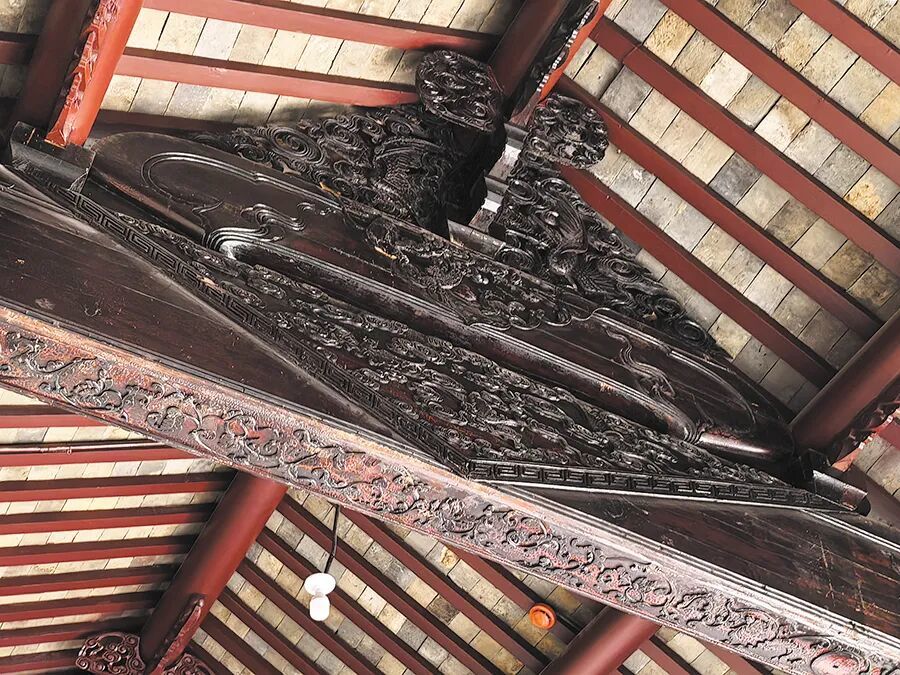
A baofujin wood carving on a beam was found during an old house restoration near Yangyu Lane in Suzhou. [PHOTO BY WANG KAIHAO/CHINA DAILY]
Crafts meet change
Xue Lingen, 74, is a master restorer from the Xiangshan group, which traces its lineage to generations of artisans and architects involved in major construction projects, including the Forbidden City in Beijing.
Following in his father's footsteps, Xue helped restore almost all of Suzhou's classical gardens inscribed on the World Heritage List, as well as numerous other landmark historic buildings across the city. Yet, when invited to oversee the restoration of residential properties, he admits that the work presented a new challenge.
"We have to anticipate residents' needs and incorporate them into the blueprints," he says. "We cannot simply rely on experience."
For example, modern restorers consider how to design a space that hides air conditioner external units or how to use steel plates to reinforce an endangered wall.
As long as the remaining structure is sound and original materials can be reused, they are retained to minimize intervention, Xue says.
"Old roof ridges have a distinctive historical character, so it is better to leave them untouched, too," he adds.
Nevertheless, modern engineering techniques, including 3D laser scanning, overall structural correction and high-ductility concrete reinforcement, are employed when necessary.
Xue Dong, a garden designer and architect, is Xue Lingen's son.
"In the past, restorers of ancient buildings tended to focus more on appearances than on the needs of those using them," Xue Dong says. "But people now understand that putting a building to good use is itself an important form of protection. We are constantly seeking a balance between preserving its historical character and making it suitable for modern users."
The restoration work also incorporates academic research. As part of the latest project, Xue Dong led a study of traditional paintwork in Suzhou residences to establish reference models for future restoration projects.
"When original elements are missing, we must conduct rigorous comparative research using historical records before drawing up an appropriate restoration plan," he says.
Xu from the district's cultural heritage protection and management center likens the work to archaeology.
"Layers of the ground have accumulated over time, preserving a wealth of historical information," he says. "Unexpected discoveries also emerge when rooms are cleared out."
In a Qing-era house near Yangyu Lane, restorers uncovered an exquisite wooden carving of baofujin, a pattern resembling brocade wrapped in cloth, on a beam. The motif is commonly found in decorative paintings, but Xu says this is the only known example of it in wood carving in Suzhou.
"The project provides a valuable platform for passing down the craftsmanship of the Xiangshan group," he says. "It also allows us to nurture a new generation of restorers with a deep respect for history."
When inspecting restoration sites, Xue Lingen often carries a handwritten note to remind younger restorers of the principles they should follow. It lists 12 basic technical methods and highlights one guiding principle: "Protection is the primary mission, with rescue work given priority."
More possibilities ahead
Beyond restoring residences, the project is opening new possibilities for historic houses by involving a wider range of people in their future development.
One example is the 200-year-old Jiyang Yizhuang.
Originally established by the Ding family to educate children and support less fortunate members of the clan, it was later converted into a factory. Before restoration, as many as 20 families were living in the 933-square-meter compound. All chose to move out.
The property has since been transformed into a leisure complex, with a teahouse, restaurant and gallery, and has begun welcoming visitors.
Another prominent residence included in the project once belonged to Wu Tingshen (1773-1844), a high-ranking official who came first in the imperial examinations. Besides a small exhibition hall showcasing his life and achievements, the compound now offers dining, intangible cultural heritage experiences and creative souvenirs.
"More historic houses will find suitable ways to be revitalized," Xu says. "This will allow their full value to be brought to light."
Suzhou is one of the first two places selected for the lottery-funded conservation program, alongside Shexian county in Anhui province. Since then, the initiative has expanded to other parts of the country.
Xian Wangjuan, deputy secretary-general of the China Foundation for Cultural Heritage Conservation, says about 316 million yuan has been allocated since 2024 to support the restoration of 1,490 old buildings in 11 provinces, including Guangdong, Shaanxi, and Shandong. Their combined floor area totals 680,000 sq m, roughly equivalent to the Forbidden City.
China has registered 767,000 immovable cultural heritage sites, mainly ancient buildings and historic monuments, according to the National Cultural Heritage Administration. More than 70 percent have yet to receive formal protection at the national, provincial or municipal level.
"More tailored policies, long-term mechanisms and broader participation from society will help strengthen the system for protecting and monitoring these undesignated sites," Deng Chao, deputy director of the administration, said at a news conference in Beijing last month, outlining the 15th Five-Year Plan (2026-30) for cultural heritage.


姑苏发布出品
来源丨中国日报
编辑丨小妤
统筹丨刘志昊 李辰茜
马上分享小伙伴↓↓↓
本文来自大风号,仅代表大风号自媒体观点。
